
Commercial HVAC incentive programs, rebate amounts, and eligibility requirements change periodically. Always verify current program details before making purchasing decisions or beginning a retrofit project.
Key Takeaways
- A commercial HVAC capital plan helps building owners replace aging equipment strategically rather than reacting to unexpected failures.
- Incentives from FortisBC, BC Hydro, and other programs should support your long-term investment strategy – not determine it.
- Planning HVAC upgrades years in advance can improve budgeting, reduce downtime, and increase the likelihood of qualifying for available incentive programs.
- Building assessments, equipment lifecycle analysis, and phased implementation often deliver better financial outcomes than emergency replacements.
- Commercial facilities throughout Metro Vancouver and the Fraser Valley can benefit from combining equipment modernization with building automation, controls, and energy efficiency improvements.
Quick Answer
A commercial HVAC capital plan is a long-term strategy for replacing and upgrading major mechanical systems before they fail. By planning equipment replacements years in advance, building owners can better manage budgets, reduce downtime, improve energy performance, and increase opportunities to qualify for available BC incentive programs.
Commercial HVAC Capital Planning Is More Than Budgeting
Many commercial building owners don’t think about HVAC systems until something stops working.
A rooftop unit fails in the middle of July. A boiler reaches the end of its service life during winter. A make-up air unit begins affecting indoor comfort or disrupting operations.
These situations often lead to emergency equipment replacement, compressed project timelines, and limited opportunities to evaluate more efficient technologies or available funding programs.
A commercial HVAC capital plan changes that approach.
Rather than reacting to equipment failures, capital planning allows organizations to evaluate the condition of existing mechanical systems, forecast future replacement needs, prioritize investments, and coordinate projects over several years.
For commercial property owners across Metro Vancouver and the Fraser Valley, this proactive strategy often leads to lower lifecycle costs, improved building performance, and greater flexibility when incentive opportunities become available.
What Is a Commercial HVAC Capital Plan?
A commercial HVAC capital plan is a long-term strategy for managing major mechanical assets throughout their expected service life.
Instead of asking:
“What do we need to replace this year?”
Facility managers ask:
“What should we replace over the next five to ten years, and when is the best time to do it?”
A comprehensive capital plan typically evaluates:
- Equipment age
- Remaining useful life
- Maintenance history
- Operating costs
- Energy performance
- Building occupancy requirements
- Future expansion plans
- Budget priorities
- Opportunities to improve efficiency during planned replacements
This approach helps organizations make informed investment decisions while minimizing disruption to tenants, employees, customers, and daily operations.
Why Waiting for Equipment Failure Can Cost More
One of the most expensive HVAC strategies is waiting until equipment fails before making replacement decisions.
Emergency replacements often create unnecessary challenges, including:
- Limited equipment selection
- Higher labour costs
- Expedited shipping expenses
- Operational downtime
- Reduced design flexibility
- Missed opportunities to improve overall building performance
Perhaps most importantly, emergency projects may not allow enough time to apply for incentive programs that require planning or pre-approval before equipment is installed.
When replacement decisions are made under pressure, organizations often focus on restoring service as quickly as possible rather than evaluating the most effective long-term solution.
Expert Insight
Commercial HVAC equipment rarely fails without warning.
Declining efficiency, increasing repair frequency, inconsistent temperatures, rising energy consumption, and occupant comfort complaints often indicate that major components are approaching the end of their useful life. Recognizing these warning signs early gives facility managers time to evaluate replacement options, compare technologies, and coordinate projects with broader capital improvement plans.
Why Incentives Should Support Your Strategy -Not Define It
One of the biggest misconceptions surrounding commercial HVAC rebates is that organizations should replace equipment simply because funding is available.
In reality, successful capital planning begins with operational needs.
Questions building owners should ask include:
- Is the equipment approaching the end of its useful life?
- Are maintenance costs increasing every year?
- Is energy consumption becoming difficult to control?
- Are tenants or occupants experiencing comfort issues?
- Will the equipment still support business operations over the next decade?
Only after these questions have been answered should available incentives become part of the financial analysis.
Rebates, grants, and tax credits can improve return on investment, shorten payback periods, and reduce upfront costs – but they should complement a sound capital strategy rather than drive it.
Building Owners Across BC Are Planning Further Ahead
Commercial buildings are becoming more complex.
Office buildings require greater occupant comfort and indoor air quality.
Industrial facilities need reliable process ventilation and temperature control.
Warehouses depend on dependable HVAC systems to protect inventory and maintain productive working conditions.
Healthcare facilities, educational institutions, retail centres, and municipal buildings each have unique operational requirements.
Throughout Vancouver, Burnaby, Richmond, Surrey, Langley, Abbotsford, and Chilliwack, many organizations are shifting from reactive maintenance toward long-term capital planning to improve reliability, reduce operating costs, and better align HVAC investments with broader business objectives.
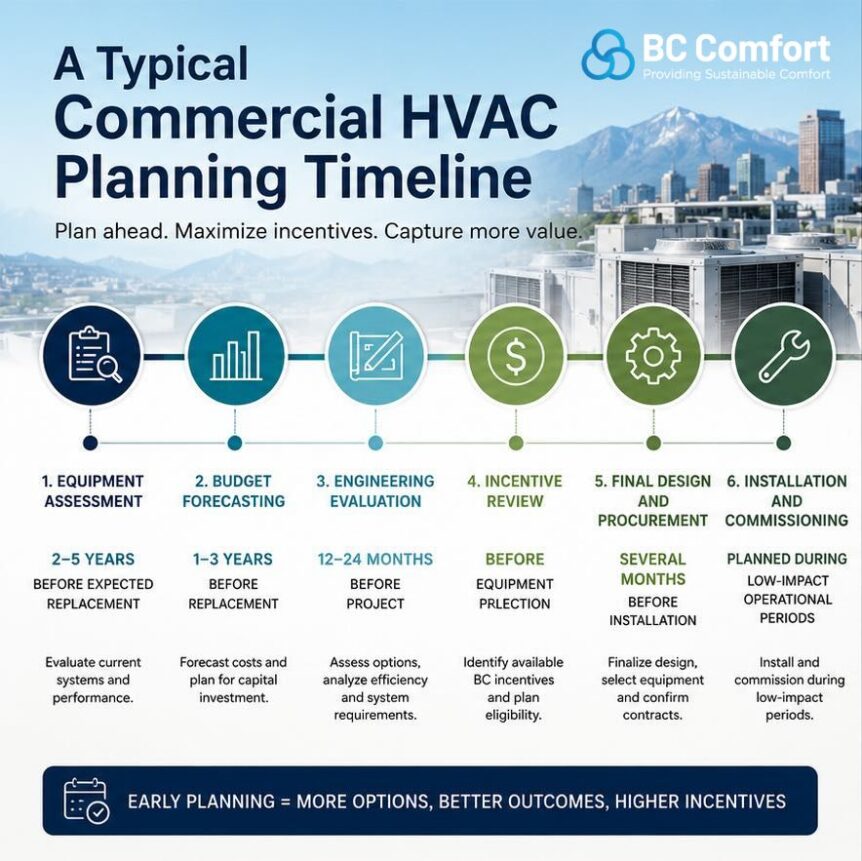
A Typical Commercial HVAC Planning Timeline
Although every facility is different, many organizations begin evaluating replacement options well before equipment reaches the end of its service life.
| Planning Stage | Typical Timing |
|---|---|
| Equipment assessment | 2–5 years before expected replacement |
| Budget forecasting | 1–3 years before replacement |
| Engineering evaluation | 12–24 months before project |
| Incentive review | Before equipment selection |
| Final design and procurement | Several months before installation |
| Installation and commissioning | Planned during low-impact operational periods |
This timeline gives building owners greater flexibility to compare technologies, coordinate contractors, and determine whether available incentive programs may improve project economics.
What Should Be Included in Every HVAC Capital Plan?
A successful capital plan evaluates far more than equipment age.
Important considerations include:
Existing Equipment Inventory
Every major mechanical asset should be documented, including:
- Rooftop units
- Boilers
- Chillers
- Heat pumps
- Make-up air units
- Ventilation systems
- Building automation controls
- Exhaust systems
Knowing what equipment exists -and its condition – is the foundation of every long-term planning strategy.
Remaining Equipment Life
Manufacturers often provide estimated service life ranges, but actual lifespan depends on maintenance practices, operating conditions, and equipment usage.
A professional assessment can identify systems that still have useful life remaining and those that should become higher priorities for replacement planning.
Operational Risk
Some equipment is mission-critical.
For example, a manufacturing facility in Langley may depend on ventilation systems to maintain production quality, while a healthcare facility in Vancouver cannot risk extended HVAC downtime.
Understanding operational risk helps prioritize capital investments based on business impact rather than age alone.
How to Phase Commercial HVAC Projects Effectively
Not every commercial HVAC upgrade needs to happen at the same time.
A well-developed capital plan allows organizations to prioritize projects based on equipment condition, operational risk, energy performance, and available budgets.
A phased approach can help building owners:
- Spread capital costs over multiple budget cycles
- Reduce disruption to building operations
- Coordinate upgrades with planned maintenance periods
- Improve the likelihood of qualifying for incentive programs
- Prioritize the equipment creating the greatest operational risk
For example, a commercial property in Surrey may begin by replacing aging rooftop units that require frequent repairs, while a warehouse facility in Abbotsford may prioritize ventilation improvements and controls upgrades before larger equipment replacements.
The right sequence depends on the building’s operational requirements and long-term objectives.
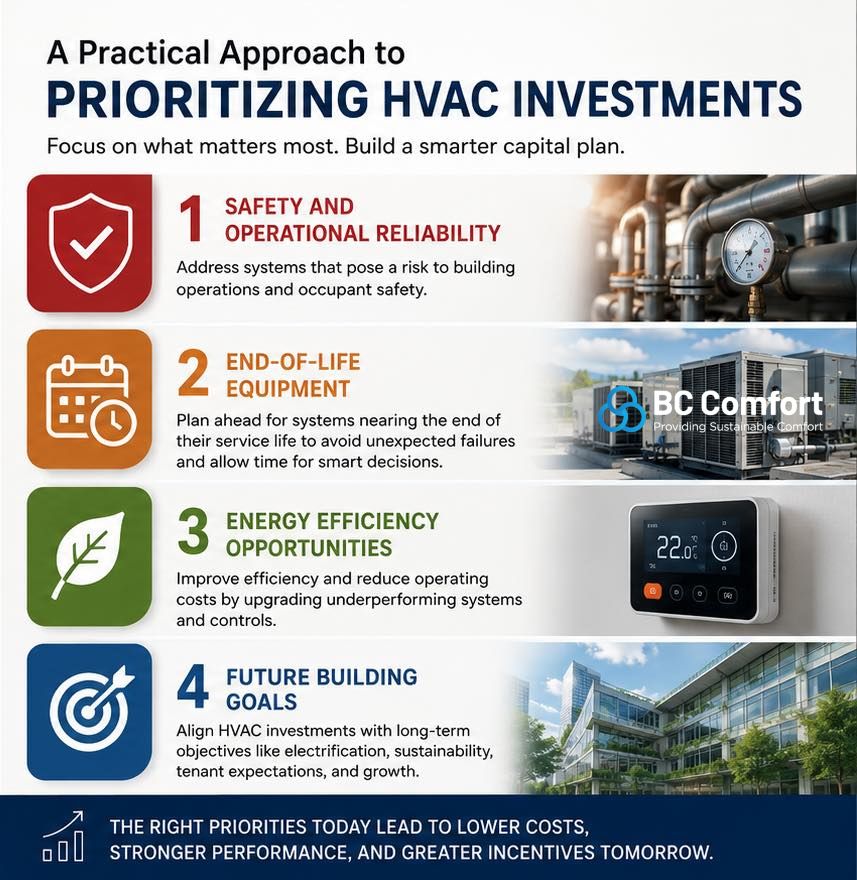
A Practical Approach to Prioritizing HVAC Investments
Facility managers often have multiple HVAC systems competing for attention. A priority ranking helps determine which projects should move forward first.
Priority 1: Safety and Operational Reliability
Equipment that creates a risk to building operations should receive immediate attention.
Examples include:
- Failing heating systems
- Poor ventilation performance
- Equipment causing production interruptions
- Systems with discontinued parts availability
Priority 2: End-of-Life Equipment
Equipment approaching the end of its expected service life should be evaluated before failure occurs.
This provides time to:
- Compare replacement options
- Review efficiency improvements
- Evaluate electrification opportunities
- Plan budgets
- Coordinate installation timing
Priority 3: Energy Efficiency Opportunities
Some systems may still be operating but represent significant efficiency opportunities.
Examples include:
- Outdated controls
- Inefficient rooftop units
- Poor scheduling settings
- Lack of energy recovery
- Unbalanced ventilation systems
Priority 4: Future Building Goals
Long-term planning should consider future objectives such as:
- Building electrification
- Lower operating costs
- Sustainability targets
- Tenant expectations
- Facility expansion
How to Coordinate HVAC Projects With BC Incentive Programs
One of the biggest advantages of early planning is having time to evaluate available incentive opportunities.
Commercial incentive programs in British Columbia may support projects involving energy efficiency improvements, HVAC modernization, controls upgrades, and building performance improvements.
Programs from organizations such as FortisBC, BC Hydro, and CleanBC can change over time, so building owners should confirm current requirements before starting a project.
However, the general process remains consistent:
Step 1: Assess Existing Systems
Before applying for funding, organizations need a clear understanding of:
- Current equipment performance
- Energy consumption
- Replacement needs
- Improvement opportunities
A strong application starts with a well-defined project.
Step 2: Identify Eligible Improvements
Potential incentive-supported improvements may include:
- High-efficiency HVAC equipment
- Heat pump systems
- Building automation upgrades
- Controls improvements
- Energy recovery solutions
- Heating system optimization
Step 3: Complete Required Applications Before Installation
A common mistake is beginning a project before confirming incentive requirements.
Many programs have specific processes regarding:
- Project eligibility
- Equipment requirements
- Documentation
- Approval timelines
Planning early gives building owners more flexibility and reduces the risk of missing available funding opportunities.
Common Mistakes That Cause Businesses to Miss HVAC Funding Opportunities
Even well-planned projects can lose access to incentives because of avoidable mistakes.
Starting Construction Too Early
Beginning installation before completing required applications or approvals can affect eligibility.
The planning stage is often where the greatest financial opportunities are identified.
Selecting Equipment Before Evaluating the Building
Choosing equipment based only on replacement cost can result in missed opportunities.
A proper assessment should consider:
- Building loads
- Operating schedules
- Future needs
- Energy goals
- Available technologies
Focusing Only on Equipment Cost
The lowest upfront price does not always create the lowest long-term cost.
A more complete evaluation considers:
- Energy consumption
- Maintenance requirements
- Equipment lifespan
- Comfort improvements
- Operational reliability
Ignoring Controls and System Integration
Replacing equipment without improving controls can limit the performance of the entire HVAC system.
Modern HVAC projects often achieve better results when equipment upgrades are combined with automation improvements.
Commercial HVAC Planning Checklist
Before beginning a major HVAC project, facility managers should review:
| Planning Area | Questions to Consider |
|---|---|
| Equipment Condition | Which systems are approaching end-of-life? |
| Maintenance History | Are repair costs increasing? |
| Building Needs | Have occupancy or operational requirements changed? |
| Energy Performance | Are there opportunities to reduce operating costs? |
| Electrical Infrastructure | Can existing systems support future upgrades? |
| Controls | Are building automation systems outdated? |
| Incentives | Have available programs been reviewed before starting work? |
| Budget Planning | Can upgrades be phased over several years? |
| Business Impact | How will installation affect daily operations? |
Commercial HVAC Planning in Metro Vancouver and the Fraser Valley
Commercial buildings throughout British Columbia face different HVAC challenges depending on their location and use.
A high-rise office building in Vancouver may prioritize occupant comfort, ventilation, and energy management.
An industrial facility in Delta or Surrey may focus on reliability, process requirements, and maintaining production schedules.
A warehouse or distribution centre in Langley, Abbotsford, or Chilliwack may require dependable heating, ventilation, and cooling solutions to support daily operations.
A successful capital plan considers the specific needs of the facility rather than applying a one-size-fits-all approach.
Expert Insight: The Best HVAC Projects Start Years Before Installation
The most successful commercial HVAC upgrades rarely begin when equipment fails.
They begin when facility managers identify future needs, evaluate options, and create a roadmap.
Early planning provides time to compare technologies, coordinate budgets, review incentive opportunities, and select solutions that support the building’s long-term goals.
For commercial property owners, HVAC planning is not simply an equipment replacement decision. It is an investment strategy that affects operating costs, reliability, occupant experience, and asset value.
People Also Ask: Commercial HVAC Capital Planning
How far in advance should a business plan for HVAC replacement?
Many organizations begin evaluating major HVAC replacements several years before equipment reaches the end of its expected service life. Early planning allows time for budgeting, engineering assessments, incentive review, and project scheduling.
Should businesses replace HVAC equipment before it fails?
In many cases, yes. Proactive replacement allows businesses to avoid emergency costs, reduce downtime, and evaluate more efficient solutions before a failure occurs.
Can HVAC upgrades improve commercial building value?
Yes. Modern HVAC systems can improve energy performance, reliability, occupant comfort, and operational efficiency, which may contribute to stronger building performance and long-term asset value.
Are HVAC incentives available for existing commercial buildings in BC?
Many existing commercial buildings may qualify for energy efficiency incentives depending on the equipment, project scope, and program requirements. Eligibility should always be confirmed before starting a project.
Can older commercial buildings be upgraded for better efficiency?
Yes. Many older buildings can improve performance through equipment upgrades, controls improvements, ventilation enhancements, and phased modernization strategies.
Frequently Asked Questions About Commercial HVAC Capital Planning
A commercial HVAC capital plan is a long-term strategy for managing HVAC replacements, upgrades, and modernization projects. It helps building owners forecast costs, prioritize investments, and avoid unexpected equipment failures.
HVAC capital planning helps reduce emergency repairs, improve reliability, manage budgets, and identify opportunities to improve energy performance before equipment failures occur.
Replacement timing depends on equipment age, maintenance history, repair costs, efficiency, and operational importance. A professional assessment can help determine whether repair or replacement provides the better long-term value.
Yes. Many organizations complete HVAC improvements over several years by prioritizing the systems with the highest operational impact.
Businesses should evaluate incentives during the planning stage, before equipment purchases or installation begins, to understand eligibility requirements and available opportunities.
Office buildings, warehouses, industrial facilities, healthcare facilities, schools, retail centres, and institutional buildings can all benefit from proactive HVAC planning.
Yes. Building automation and controls improvements are often an important part of modernization because they help optimize equipment performance and energy use.
Most organizations review their HVAC capital plan annually or whenever there are significant changes to equipment, building use, or operational requirements.
BC Comfort helps commercial, industrial, and institutional clients throughout Metro Vancouver and the Fraser Valley assess HVAC systems, identify upgrade priorities, and develop practical modernization strategies.
Planning Your Next Commercial HVAC Investment
A commercial HVAC capital plan gives building owners control over future investments instead of forcing decisions during unexpected failures.
By evaluating equipment condition, prioritizing improvements, and considering available incentive opportunities early, organizations can make smarter decisions that improve reliability, efficiency, and long-term building performance.
BC Comfort works with commercial clients throughout Metro Vancouver and the Fraser Valley to assess HVAC systems, plan upgrades, and deliver solutions designed around each facility’s operational requirements.
Whether planning a rooftop unit replacement, controls upgrade, electrification project, or larger HVAC modernization, the right strategy begins with understanding your building today and preparing for its future needs.